Saturday, 14 January 2012

Recently Published


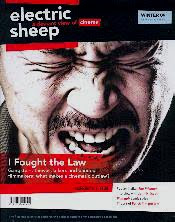
My essay on Stephen Volk's notorious BBC drama hoax Ghostwatch has just been published in the January 2012 edition of Electric Sheep. The text examines the genesis of the program and how it used the codes and conventions of the live broadcast coupled with elements 'borrowed' from other programs such as Crimewatch to create an intensely real drama that convinced the nation's audience that not only was a house really haunted but also that popular TV presenter Sarah Greene was trapped alone with the restless spirits...

Here is a brief extract:

This graphic escalation of events should have been enough of an indicator to the audience that Ghostwatch was indeed fake, but such was the quality of the programme’s verisimilitude that the spectral events sustained the illusion of reality instead of breaking it. Herein lies the programme’s greatest strength: it mimics the visual language of reportage television so fluently that its fiction is, in some way, successfully incorporated into the illusion. The expected unsteady camera work, the poorly composed images as the cameraman adjusts his framing, the use of cutaways, vox pop and live calls all function to create a genuinely frightening work of fiction while simultaneously declaring it as real. It is the perfect synthesis of technical craft and concept, a true perversion of the language of television.

To read the full text, follow this link.

Sunday, 11 December 2011

Recently Published


My article Girl Power: The Politics of the Slasher Movie has just been published in the December 2011 edition of MediaMagazine. Here is a brief extract:

As can be seen from this selection of endings, The Final Girl uses her weapon to cut off body parts and/or impale the male killer. Given the nature of the sexualised murders throughout the film and the weapons used by The Final Girl, it can be suggest that the climatic death of the killer is a symbolic castration – The Final Girl not only kills the killer but ‘removes’ their masculinity before doing so by either disarming them or cutting off their limbs or heads. Because of this, it can be argued that the repressed virginal Final Girl is freed at the narrative’s conclusion because she has given vent to her (sexual) repressions and emerges from the narrative having killed the symbol of male dominance and sexual threat. Consequently, she becomes her adult herself – capable, in charge and powerful, both feminine and masculine, entering into the adult world on her terms, making her choices and succumbing to no one.


To order a copy of this edition of MediaMagazine, click here.

Sunday, 27 November 2011

Recently Published


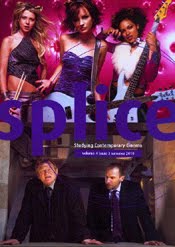
My essay on Kathryn Bigelow's The Hurt Locker has just been published in the Autumn/Winter edition of Splice. The text provides a critical overview of the film and examines its place in Post 9/11 cinema before engaging in a comparative analysis of two of the film's central characters - Sergeant Matt Thompson (Guy Pierce) and Staff Sergeant William James (Jeremy Renner). Here is a brief extract:

The Hurt Locker: War is a Drug

The Hurt Locker begins with, and is wholly contextualised by, a quote from Chris Hedges’ book War Is a Force That Gives Us Meaning (2002). ‘The rush of battle is often a potent and lethal addiction for war is a drug’. After a few moments, the majority of the text fades away leaving only the last four words, ‘war is a drug’, and remains there for a further few moments. Bigelow defines the meaning of the quote through her description of the book, explaining it as one in which Hedges


talks about that you’re looking today at a volunteer military and one of the many things he confronts is war’s dirty little secret in [that] some men love it. This isn’t everybody; it’s just a particular type of psychological state with some men. There’s a psychological allure that combat creates, some kind of attractiveness, and it does create an almost additive quality that you can’t replicate in any other way and are lost in any other context. (Axmaker, 2010)


As a context for the film, the quote becomes quite literal for it clearly defines James’ emotional and psychological relationship to his employment as a bomb disposal expert – he is addicted to all aspects of this role: disposing bombs in an increasingly dramatic (and perhaps theatrical) manner, saving lives of both his men and civilians, acting alone in order to continually push himself and, ultimately, to be good enough each time to ‘cheat’ death once more. As a consequence, the quote, quite literally, states that James’ is addicted to war but, on a more complex level, indicates that James’ is addicted to a repeated confrontation with his mortality. Each IED to be disarmed challenges him to gamble, with the highest stakes possible, his skill and ability to perform under pressure against both an incredibly violent but inanimate object and an equally threatening but unseen enemy.


This edition of Splice can be ordered from Auteur Publishing by following this link.

Saturday, 29 October 2011

Recently Published


Interview with Marc Price, the director of Colin

My interview with Marc Price, the director of the British low-budget zombie film Colin has just been published online at Offscreen. Here is a brief extract...

When did your interest in filmmaking begin?

It’s a difficult one to sort of pin down. I think the big thing that happened was that when I was younger I watched movies like Superman 2 and the Star Wars movies – and this is just me speculating – my dad took me to the cinema to see… I can’t remember! I kind of like that I don’t know! I don’t know whether Superman 3 or Return of the Jedi came out first? I went to see one of those movies in the cinema and there was something about seeing characters that I was familiar with on a gigantic screen with loads of people reacting to what was happening. I think maybe something kind of got me there so film was obviously the exciting medium for me. I was raised up on blockbuster and genre films specifically so it started off as entertainment but then as I got older I started to discover other films as well. I didn’t turn my back on genre; I think genre is a really important type of film with an awful lot to offer.

Did any of these films influence you when you were writing and directing Colin or was it zombie cinema in more general that influenced you?

In a way I think they are all wired in but I think when it came to Colin I think it owes a lot more to King Kong than any other zombie film specifically. It obviously references Bub from Day of the Dead – a character I am clearly attracted to. What I really liked about Kong was the connection between Kong and the audience is only said between Kong and the audience. The other characters in the film don’t accept him in quite the same way. I kind of thought, that’s a really amazing thing that an audience is so capable of making that connection. I thought that would be the way to go so the idea with Colin was to find ways to put on the audience the awareness of any danger that Colin would be in that that character wouldn’t be aware of because of the lack of cognitive thought. That was the idea really, to look at the audience’s relationship with the character and to find a way to make that work in the same way that it did for me with King Kong.

To read the interview at Offscreen, follow this link.

Wednesday, 14 September 2011

Recently Published


World Film Locations: London

World Film Locations: London is an exciting visually focused tour of a diverse range of films shot on location in London. This volume will contain concise but knowledgeable reviews of carefully chosen film scenes and evocative essays about key directors, themes, ideas and historical periods that explore London's relationship to cinema. This book will be illustrated throughout with scene-specific screengrabs, stills of filming locations as they appear now and city maps that include location information for those keen to investigate the cinematic landmarks of London. The individual scene reviews, theme specific essays and illustrations will collectively offer up their own wider questions relating to London itself and how cinema shapes our view of the city. Covering the periods of the Victorian era via the swinging 60s through to the post 7/7 atmosphere of modern day London and seen through the eyes of the full range of communities that have been portrayed onscreen World Film Locations: London will illuminate all corners of this richly diverse and cinematically fertile city.

Edited by Neil Mitchell and published by Intellect, my contribution examines the relationship between the London Underground and the horror film, including Quatermass and the Pit, Death Line and An American Werewolf in London.

You can buy the book online at amazon by following this link or direct from Intellect Books by following this link.

Wednesday, 7 September 2011

Recently Published


The latest edition of MediaMagazine (September 2011) features my extended essay analysing the Omaha Beach Landing sequence at the start of Steven Spielberg's Saving Private Ryan. Accompanied by a one-page frame-by-frame illustration, the text examines the rationale behind the sequences Vérité style and the shift in the meaningful value of the shots used by Spielberg. Here is a brief extract:

For Miller, the slow motion functions as a representation of how he is witnessing the events for it visualises the horror of his experience - he is surrounded by a chaos of noise and movement, seeing not only death but the dreadful massacre of his men, all of which is too much for him to comprehend or bear witness to. The effect of the slow motion amplifies the horror by fragmenting its depiction into briefly frozen moments; but it also implies that Miller himself is trying to edit out the intensity of the violence by 'missing out' certain frames of action.

To order a copy of this edition of MediaMagazine, click here.

Friday, 2 September 2011

Forthcoming Publication

I recently wrote an essay for World Film Locations: London. Edited by Neil Mitchell and published by Intellect, my contribution examined the relationship between the London Underground and the horror film, including Quatermass and the Pit, Death Line and An American Werewolf in London.


As described on the Intellect website, the book

is an exciting visually focused tour of a diverse range of films shot on location in London. The volume will contain concise but knowledgeable reviews of carefully chosen film scenes and evocative essays about key directors, themes, ideas and historical periods that explore London's relationship to cinema. The book will be illustrated throughout with scene–specific screengrabs, stills of filming locations as they appear now and city maps that include location information for those keen to investigate the cinematic landmarks of London. The individual scene reviews, theme specific essays and illustrations will collectively offer up their own wider questions relating to London itself and how cinema shapes our view of the city. Covering the periods of the Victorian era via the swinging 60s through to the post 7/7 atmosphere of modern day London and seen through the eyes of the full range of communities that have been portrayed onscreen World Film Locations: London will illuminate all corners of this richly diverse and cinematically fertile city.


World Film Locations: London (ISBN 9781841504841)
will be published on
12th September 2011.


Order your copy through the following links:

Intellect Publishing

Amazon.co.uk

Wednesday, 15 June 2011

Recently Published


My essay A Good Man, Dreadfully Punished: Frank Darabont's The Mist, has just been published in the first Electric Sheep Anthology, The End. The text is a 'fictional' adaptation of the events leading up to the downbeat conclusion of The Mist, examining what the end of the narrative signifies for the film's protagonist as well as the other minor characters within the film.

Here is a brief extract...
'It's the End of Days,' murmurs Mrs Carmody. The mist, dreadful in its density, rolls against the glass frontage, pressing against it as if it wrre a solid mass, sealing off the customer's view and stranding them in the supermarket. The large panes, reinforced, may later bow, crack, splinter and break but for now, at least, they hold.

The book is available via Strange Attractor Press by following this link.

Saturday, 28 May 2011

Online Publications

A resume of my online publications has just been added to the right-hand navigation bar - scroll down just past the magazine cover images to find the hyperlinked list. Click on the underlined journal titles to read the various texts. Here is a small selection, all concerning film director Richard Stanley...

Between the Dust and the Devil: An Interview with Richard Stanley at The Irish Journal of Gothic and Horror Studies

The Light and the Darkness: Myth in the Films of Richard Stanley
at Senses of Cinema

Reading the Darkness: The Documentary Films of Richard Stanley
at Vertigo

Tuesday, 12 April 2011

Recently Published


My essay Quid Pro Quo: Visiting Doctor Lecter has just been published in the April 2011 edition of MediaMagazine. The text examines the collaborative partnership that occurs between trainee FBI Agent Clarice Starling and imprisoned cannibal Dr Hannibal Lecter and how this relationship may lead to a mutual attraction ...

...the quid pro quo develops to such an extent it becomes apparent that Lecter and Starling may be, in some way, attracted to each other. This is not necessarily sexual but more through a shared interest in the other's psychology: Lecter's interest in Clarice can be read as one in which he attempts to heal her psychological problems while Clarice's interests in him allows him the opportunity to express his intellect and demonstrate his great skill in profiling. Consequently, their collaboration simultaneously functions not only to construct a profile of Buffalo Bill but also to allow each other to explore the other's psychology.


To order a copy of the April 2011 edition of MediaMagazine, click here.

Saturday, 9 April 2011

Recently Published


My short essay on Tim Burton has just been published in the latest edition of Electric Sheep - Being Tim: Alienated Biography in the Cinema of Tim Burton examines the relationship between Burton and his protagonists and how they make manifest the condition of alienation...

This idea of alienation shaping a persona’s interaction with the world is evident in Burton’s protagonists: the animated Vincent Malloy channels the everyday world through his imagination and transforms it into a tragic rendering of Poe’s work; Lydia Deitz would rather be dead than endure her parents Technicolor world and so sides with the ghostly Maitlands; orphaned as a child, the young Bruce Wayne evolves into an isolated figure bent on revenge that he hopes will positively transform the world he is apart from; Edward’s experience in ‘normality’ not only highlights his difference but enhances his emotions and creativity; Jack Skellington’s desire to be Sandy Claws not only leads to chaos and destruction, but also to the realisation that he is better off doing what he does best – ruling the land of which he is king. The connections and parallels sustain themselves throughout Burton’s oeuvre to the extent that, in the end, perhaps Tim Burton’s films are a unified project because they are a repeated filmic attempt at a constructed and now expected self-portrait.


To read the full essay,please follow this link - Electric Sheep - and leave a comment!


Thursday, 10 March 2011

Recently Published

My essay, A Very British Doctor, has been published in the February issue of MediaMagazine as part of their Culture special. The essay examines representations of Britishness in the Russell T. Davies era of Doctor Who, taking in a (albeit brief) history of Torchwood along the way. I wrote quite an extensive examination, some of which had to be edited out. Here's a snippet of what fell to the cutting room floor...

…Torchwood’s Yvonne Hartman, by the end of Doomsday, transgresses her xenophobic attitude: although been upgraded into a Cyberman herself, she holds on to her human identity and, in a final act of defiance against the Cybermen, overcomes her programming and fights against them. With gun in hand she kills numerous Cybermen, all the while chanting a mantra of “I fought for Queen and Country”. Her final act is one of defending the borders but not of Torchwood’s Victorian ideals but of contemporary Britain – Hartman’s destruction of the Cybermen indicates it is better to be individual and diverse than to be one and the same.

Such an attitude is extended into the character of Captain Jack Harkness, the leader of Torchwood Three, who acts as the bridge between both Doctor Who and Torchwood. As an Ominsexual, Harkness shares and later embodies the Doctor’s attitude to diversity and difference. Harkness seeks to rework Torchwood for within, changing its agenda and forcing it to protect and serve the populace instead of empire building.

Sunday, 6 March 2011

Recently Published


Earlier this week I received my Contributor Copy of The Unsilent Library. The book, published by The Science Fiction Foundation, is a collection of ten essays about the Russell T. Davies era of Doctor Who. My contribution, titled Conflict, Hybridity and Forgiveness examines the series' narrative arc of the Time War and how this affects the Doctor and his experinces with alien threats, most notably the Daleks.

The book is avaible from both The Science Fiction Foundation and Amazon.

Sunday, 16 January 2011

Beyond Hammer Review

I recently came across a review of my first book, Beyond Hammer: British Horror Cinema Since 1970 in Morpheus Tales: reviewer Adrian Brady said:
"This is the sort of book that all film students should read... For me it was an enjoyable and insightful experience, as a horror film fanatic there are those rare treats of film books, and this is definitely one of those."
My thanks to Adrian for such a fantastic review.

Thursday, 23 December 2010

Studying The Devil's Backbone Review

This morning I received another review for my second book, Studying The Devil's Backbone: published by the MEA (Media Education Association), the review is, as with the previous review by Mary Birch, a thorougher and concise review of the text:
"This book has a real academic feel to it and it has clearly been extremely well researched... a detailed look at the eight page filmography and bibliography makes it clear that James Rose has really done his research."

"James Rose has also clearly done some very in-depth research into the Gothic and its influence on del Toro's work as a whole... James Rose has done an excellent job at communicating the key information of this film and his work on analysing it makes it an invaluable resource."
My thanks to Andrea Joyce for taking the time to read the book and to provide such a positive review.

Tuesday, 21 December 2010

Studying The Devil's Backbone Review

Issue 48 of the Media Education Journal (Winter 2010/2011) has published a lengthy review of my second book, Studying The Devil's Backbone, by Mary Birch. The review examines the book in some detail and so provides an extensive means by which to critique the text:
"The film is essentially a Spanish horror film and the writer, James Rose, has an impressive background in analysing this type of genre, having written for a number of international journals as well as being the author of Beyond Hammer: British Horror Cinema Since 1970."

"As well as renewing my desire to see and study this film again, I personally found that Rose’s book afforded new facts both about del Toro and the Spanish Civil War."

"I believe this book to be an accessible text both for student and teacher. Explanations of terminology are woven into the analysis in a light-handed manner and the writer demonstrates a scholarly grasp of his material."
Overall a fantastic review and my thanks to Mary Birch for taking the time to thoroughly read the book and to provide such an impressive critique of the text.

Monday, 1 November 2010

Recently Published

My first piece of Travel Writing has just been published in the November edition of Rue Morgue. Appearing in the Travelogue of Terror section of the magazine, my text is a tour of Gothic Whitby via the Whitby Dracula Walk. The article explores the influence of Whitby upon Dracula author Bram Stoker through the various locations that appear within that text and, along the way, reveals some interesting facts... such as the Russian schooner that brings Dracula to English shores was based on a real life incident involving The Dimitry - floundering off the coast of Whitby, the boat shed its cargo of coffins. For days after the coffins and/or the decomposed bodies were washed up on the shores of Tate Hill Sands.


Friday, 1 October 2010

Simeon Halligan Interview Published in Scream Magazine


The interview I conducted with UK director Simeon Halligan about his debut horror film, Splintered, has just been published in the first edition of Scream magazine. During the interview, Simeon discusses the production of the film, the conceptual background to the narrative and the post production process.

To order a copy of Scream, please visit:

Scream magazines official website

Friday, 13 August 2010

Interview Extract


A while back I interviewed UK director Simeon Halligan about his debut feature, Splintered, a psychological horror film due for cinema release from the 3rd September 2010. While the full interview is still under negotiation with potential publishers, Simeon's production company, Not a Number Productions, have posted a short extract on their site. To read the extract, please visit:

Interview Extract

To find out more about Splintered , please visit Splintered the Movie.

Tuesday, 10 August 2010

Recently Published


My essay on James Mangold's remake of 3:10 to Yuma has just been published in the latest edition of Splice: Western Myth, Historic Truth provides a critical examination of the triangular relationship between protagonist Dan Evans , his son William and the outlaw Ben Wade through the idea of the Western as a journey and through the failure of the father.

Here is a brief extract:

It could be argued that the Western is a dying genre. With its most successful period long over and contemporary popular audiences constantly desiring to see the next spectacle of high-concept cinema, the Western now seems like an outdated form of film. Its location within the past denies any sense of the special-effects driven spectacular as its physically dramatic moments relying on bar brawls, horse chases and cattle rustling, bank robberies and gunfights as opposed to interstellar combat, technological weaponry and fantastical creatures. Yet, regardless of this, the genre continues to develop, shifting and changing, responding not to the audiences visual needs but to their times. Consequently, the Western has shifted from a ‘heroic’ vision to one that is gritty, dirty and dark, a ‘truth’ as it were. In these new narratives the eternal conflict between the sheriff and the outlaw, the oppressor and the oppressed, Good and Evil, are played out in an intimate and dramatic fashion as ordinary people – as tangibly real as they get on screen – fight for their families, livelihoods, beliefs and the ‘truth’. One such film is James Mangold’s 3:10 to Yuma (2007). Contemporary Westerns, such as Yuma, elicit a powerful affect upon the viewer. They are concerned with the small but violent incidents of human interaction, morality plays in which the concerns of society are often played out. They affirm not just the ‘truth’ of the past but also the ‘truth’ of ourselves, albeit one that is safely located in the past. In essence then the contemporary Western is eclipsed by the constant roll of blockbusters, their powerful and evocative moments dismissed in favour of throw-away images, paper-thin plots and cardboard characters. To watch 3:10 to Yuma now, to discover it for the first time, is a refreshing change and a challenge to the blockbuster for it presents a tangible plot, believable characters and a tragic outcome. To ignore it would be to deny the Western one of its greatest qualities – to show us who we are and what we may become.