Tuesday, 12 April 2011

Recently Published


My essay Quid Pro Quo: Visiting Doctor Lecter has just been published in the April 2011 edition of MediaMagazine. The text examines the collaborative partnership that occurs between trainee FBI Agent Clarice Starling and imprisoned cannibal Dr Hannibal Lecter and how this relationship may lead to a mutual attraction ...

...the quid pro quo develops to such an extent it becomes apparent that Lecter and Starling may be, in some way, attracted to each other. This is not necessarily sexual but more through a shared interest in the other's psychology: Lecter's interest in Clarice can be read as one in which he attempts to heal her psychological problems while Clarice's interests in him allows him the opportunity to express his intellect and demonstrate his great skill in profiling. Consequently, their collaboration simultaneously functions not only to construct a profile of Buffalo Bill but also to allow each other to explore the other's psychology.


To order a copy of the April 2011 edition of MediaMagazine, click here.

Saturday, 9 April 2011

Recently Published


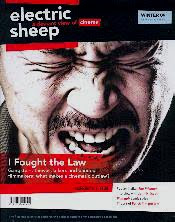
My short essay on Tim Burton has just been published in the latest edition of Electric Sheep - Being Tim: Alienated Biography in the Cinema of Tim Burton examines the relationship between Burton and his protagonists and how they make manifest the condition of alienation...

This idea of alienation shaping a persona’s interaction with the world is evident in Burton’s protagonists: the animated Vincent Malloy channels the everyday world through his imagination and transforms it into a tragic rendering of Poe’s work; Lydia Deitz would rather be dead than endure her parents Technicolor world and so sides with the ghostly Maitlands; orphaned as a child, the young Bruce Wayne evolves into an isolated figure bent on revenge that he hopes will positively transform the world he is apart from; Edward’s experience in ‘normality’ not only highlights his difference but enhances his emotions and creativity; Jack Skellington’s desire to be Sandy Claws not only leads to chaos and destruction, but also to the realisation that he is better off doing what he does best – ruling the land of which he is king. The connections and parallels sustain themselves throughout Burton’s oeuvre to the extent that, in the end, perhaps Tim Burton’s films are a unified project because they are a repeated filmic attempt at a constructed and now expected self-portrait.


To read the full essay,please follow this link - Electric Sheep - and leave a comment!


Thursday, 10 March 2011

Recently Published

My essay, A Very British Doctor, has been published in the February issue of MediaMagazine as part of their Culture special. The essay examines representations of Britishness in the Russell T. Davies era of Doctor Who, taking in a (albeit brief) history of Torchwood along the way. I wrote quite an extensive examination, some of which had to be edited out. Here's a snippet of what fell to the cutting room floor...

…Torchwood’s Yvonne Hartman, by the end of Doomsday, transgresses her xenophobic attitude: although been upgraded into a Cyberman herself, she holds on to her human identity and, in a final act of defiance against the Cybermen, overcomes her programming and fights against them. With gun in hand she kills numerous Cybermen, all the while chanting a mantra of “I fought for Queen and Country”. Her final act is one of defending the borders but not of Torchwood’s Victorian ideals but of contemporary Britain – Hartman’s destruction of the Cybermen indicates it is better to be individual and diverse than to be one and the same.

Such an attitude is extended into the character of Captain Jack Harkness, the leader of Torchwood Three, who acts as the bridge between both Doctor Who and Torchwood. As an Ominsexual, Harkness shares and later embodies the Doctor’s attitude to diversity and difference. Harkness seeks to rework Torchwood for within, changing its agenda and forcing it to protect and serve the populace instead of empire building.

Sunday, 6 March 2011

Recently Published


Earlier this week I received my Contributor Copy of The Unsilent Library. The book, published by The Science Fiction Foundation, is a collection of ten essays about the Russell T. Davies era of Doctor Who. My contribution, titled Conflict, Hybridity and Forgiveness examines the series' narrative arc of the Time War and how this affects the Doctor and his experinces with alien threats, most notably the Daleks.

The book is avaible from both The Science Fiction Foundation and Amazon.

Sunday, 16 January 2011

Beyond Hammer Review

I recently came across a review of my first book, Beyond Hammer: British Horror Cinema Since 1970 in Morpheus Tales: reviewer Adrian Brady said:
"This is the sort of book that all film students should read... For me it was an enjoyable and insightful experience, as a horror film fanatic there are those rare treats of film books, and this is definitely one of those."
My thanks to Adrian for such a fantastic review.

Thursday, 23 December 2010

Studying The Devil's Backbone Review

This morning I received another review for my second book, Studying The Devil's Backbone: published by the MEA (Media Education Association), the review is, as with the previous review by Mary Birch, a thorougher and concise review of the text:
"This book has a real academic feel to it and it has clearly been extremely well researched... a detailed look at the eight page filmography and bibliography makes it clear that James Rose has really done his research."

"James Rose has also clearly done some very in-depth research into the Gothic and its influence on del Toro's work as a whole... James Rose has done an excellent job at communicating the key information of this film and his work on analysing it makes it an invaluable resource."
My thanks to Andrea Joyce for taking the time to read the book and to provide such a positive review.

Tuesday, 21 December 2010

Studying The Devil's Backbone Review

Issue 48 of the Media Education Journal (Winter 2010/2011) has published a lengthy review of my second book, Studying The Devil's Backbone, by Mary Birch. The review examines the book in some detail and so provides an extensive means by which to critique the text:
"The film is essentially a Spanish horror film and the writer, James Rose, has an impressive background in analysing this type of genre, having written for a number of international journals as well as being the author of Beyond Hammer: British Horror Cinema Since 1970."

"As well as renewing my desire to see and study this film again, I personally found that Rose’s book afforded new facts both about del Toro and the Spanish Civil War."

"I believe this book to be an accessible text both for student and teacher. Explanations of terminology are woven into the analysis in a light-handed manner and the writer demonstrates a scholarly grasp of his material."
Overall a fantastic review and my thanks to Mary Birch for taking the time to thoroughly read the book and to provide such an impressive critique of the text.

Monday, 1 November 2010

Recently Published

My first piece of Travel Writing has just been published in the November edition of Rue Morgue. Appearing in the Travelogue of Terror section of the magazine, my text is a tour of Gothic Whitby via the Whitby Dracula Walk. The article explores the influence of Whitby upon Dracula author Bram Stoker through the various locations that appear within that text and, along the way, reveals some interesting facts... such as the Russian schooner that brings Dracula to English shores was based on a real life incident involving The Dimitry - floundering off the coast of Whitby, the boat shed its cargo of coffins. For days after the coffins and/or the decomposed bodies were washed up on the shores of Tate Hill Sands.


Friday, 1 October 2010

Simeon Halligan Interview Published in Scream Magazine


The interview I conducted with UK director Simeon Halligan about his debut horror film, Splintered, has just been published in the first edition of Scream magazine. During the interview, Simeon discusses the production of the film, the conceptual background to the narrative and the post production process.

To order a copy of Scream, please visit:

Scream magazines official website

Friday, 13 August 2010

Interview Extract


A while back I interviewed UK director Simeon Halligan about his debut feature, Splintered, a psychological horror film due for cinema release from the 3rd September 2010. While the full interview is still under negotiation with potential publishers, Simeon's production company, Not a Number Productions, have posted a short extract on their site. To read the extract, please visit:

Interview Extract

To find out more about Splintered , please visit Splintered the Movie.

Tuesday, 10 August 2010

Recently Published


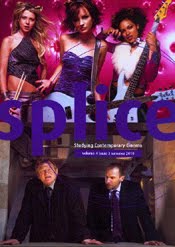
My essay on James Mangold's remake of 3:10 to Yuma has just been published in the latest edition of Splice: Western Myth, Historic Truth provides a critical examination of the triangular relationship between protagonist Dan Evans , his son William and the outlaw Ben Wade through the idea of the Western as a journey and through the failure of the father.

Here is a brief extract:

It could be argued that the Western is a dying genre. With its most successful period long over and contemporary popular audiences constantly desiring to see the next spectacle of high-concept cinema, the Western now seems like an outdated form of film. Its location within the past denies any sense of the special-effects driven spectacular as its physically dramatic moments relying on bar brawls, horse chases and cattle rustling, bank robberies and gunfights as opposed to interstellar combat, technological weaponry and fantastical creatures. Yet, regardless of this, the genre continues to develop, shifting and changing, responding not to the audiences visual needs but to their times. Consequently, the Western has shifted from a ‘heroic’ vision to one that is gritty, dirty and dark, a ‘truth’ as it were. In these new narratives the eternal conflict between the sheriff and the outlaw, the oppressor and the oppressed, Good and Evil, are played out in an intimate and dramatic fashion as ordinary people – as tangibly real as they get on screen – fight for their families, livelihoods, beliefs and the ‘truth’. One such film is James Mangold’s 3:10 to Yuma (2007). Contemporary Westerns, such as Yuma, elicit a powerful affect upon the viewer. They are concerned with the small but violent incidents of human interaction, morality plays in which the concerns of society are often played out. They affirm not just the ‘truth’ of the past but also the ‘truth’ of ourselves, albeit one that is safely located in the past. In essence then the contemporary Western is eclipsed by the constant roll of blockbusters, their powerful and evocative moments dismissed in favour of throw-away images, paper-thin plots and cardboard characters. To watch 3:10 to Yuma now, to discover it for the first time, is a refreshing change and a challenge to the blockbuster for it presents a tangible plot, believable characters and a tragic outcome. To ignore it would be to deny the Western one of its greatest qualities – to show us who we are and what we may become.

Sunday, 1 August 2010

The Mist - Electric Sheep Anthology


Electric Sheep have just announced on their website their forthcoming anthology The End to which I have contributed:
"Taking ‘The End’ as its theme, this new anthology includes essays on the bad endings of bad girls, low-end sounds in Lynch’s films, personal and collective apocalypse in Ingmar Bergman’s work, the ending of road movies, French master Henri-Georges Clouzot’s unfinished masterpiece Inferno, a graphic piece on The Night of the Living Dead and an image-based recollection of Decasia. "
My contribution is a 'fictional' adaptation of the events leading up to the downbeat conclusion of The Mist, examining what the narrative end signifies for the film's protagonist as well as the other minor characters within the film. Here is a brief extract...

The end of this story begins with a single gunshot. A murder in a supermarket, by the checkouts. There is a calling out for blood, holy justice through sacrifice. A child, blond and innocent, is first singled out and then the woman who holds him close to her. A fevered mob descends upon them both as others try to defend them. There is a lashing out with fists and makeshift weapons. As fights break out, the only armed man in the supermarket takes his pistol out from behind the waistband of his trousers, takes careful aim and slowly squeezes the trigger. The dull thud of the single shot echoes along the aisles. The bullet breaks through the milk bottle that a woman holds and enters her stomach. The fighting stops; silence as the woman falls to her knees. Her blood spills out, a deep copper red blossom that soaks into the floral pattern of her dress.

Thursday, 8 July 2010

Amazon Author Page

Amazon.com have recently set up an Author Page for me:


Here you will find out more information about myself and my books, all of which are available to buy through Amazon's ordering service.

Thursday, 1 July 2010

Beyond Hammer Review


I recently found out that the November 2009 edition of Rue Morgue published a review of Beyond Hammer: British Horror Cinema since 1970. Reviewer Justine Warwick commented that it is "an in-depth and eclectic study" and that it "is smashing stuff!" In particular, Warwick comments on the chapter concerning Shaun of the Dead, stating that "let's just say by reading [the chapter on] it you'll probably pick up a few self-referential jokes you missed on the first, sixth or even tenth viewing"!

To purchase Beyond Hammer: British Horror Cinema since 1970 please follow one of these links:

Amazon.co.uk

Columbia University Press


Play.com

Auteur Publishing

Sunday, 23 May 2010

Forthcoming Publication


I have just received an email from Chris Hansen, the editor of one of the books that I am in - Ruminations, Peregrinations and Regenerations: A Critical Approach to Doctor Who - to tell me that it has just gone to press and is now available for pre-order on Amazon. The book, as a whole, considers all aspects of the series with my chapter examining the uncanny nature of the Russell T. Davies era of Doctor Who, analysing in particular the Gothic and uncanny qualities that the Cybermen embody.

The book can be pre-ordered from both Amazon UK and US by following either of these links:

Amazon.co.uk

Amazon.com

Wednesday, 19 May 2010

Current Publications

I have over the past few months been working on a wide range of commissions, all of which are soon due for submission and publication:

The Director Series: Kathryn Bigelow
Book for Auteur Publishing

British Horror Cinema
The Directory of World Cinema: British Cinema, Intellect Publishing

The Mist
Electric Sheep

3:10 to Yuma
Splice

Body Horror
MediaMagazine

In addition to these publications I will be delivering a paper concerning Doctor Who at a conference in June (University of York) and have a travelogue piece due for publication in Rue Morgue.

Thursday, 1 April 2010

Recently Published


My article on E4's Misfits has just been published in the April 2010 edition of MediaMagazine. The text explores what it means to be both an outcast and superhero and how these qualities relate to the humorous nature of the series.

To order a copy of this edition of the magazine or to subscribe to MediaMagazine, click here.

Tuesday, 9 March 2010

Recently Published

My essay Vincent and Victor: Two Early Shorts by Tim Burton has just been published in the Winter 2009-2010 edition of Splice. The text examines the shorts as a point of origin of Burton's auteuristic traits, critiquing visual style and elements on influence throughout the two short films. As I state in the opening paragraph to the text...

"Vincent Malloy is a seven year old boy with long black, wiry hair who fantasises that he is Vincent Price. He also imagines that he conducts arcane electrical experiments on his dog in a castle perched high on a craggy hill and dreams of dipping his aunt in a vat of molten wax. Another boy, Victor Frankenstein, is older than the first. He resurrects his deceased dog after it has been knocked down by a car and together they cause havoc in the middle-class suburbia in which they live. These are two different boys but both of them grew up into one man, Tim Burton."

For further information and ordering pleas visit Auteur Publishing.

Sunday, 28 February 2010

Recently Published


My article, Reading the Apocalypse, has just been published in this quarters edition of Media Magazine: the text examines the history of the apocalypse narratives in British film and television, including The War Game, Threads and the recently revived series of Survivors. Here is a brief extract...


Throughout the steadily evolving history of the Post-apocalypse genre, those narratives based within Britain, be that film or on broadcast television, have a dominating preoccupation with two concerns: the contextual/political background to the story more often than not reflects the nation’s contemporary anxieties whilst its drama focuses on the plight of one or two families. When combined, this family becomes a metaphor for all families and so, in effect, come to represent the national experience in the face of real-world concerns. Perhaps predictably, these issues have a tendency to shift only slightly, fluctuating between the horrific consequences of a full-scale nuclear assault on mainland Britain to viral pandemics devastating the populace. In both scenarios, the causalities will be extremely high, its impact irreversibly changing the nation. And whilst these narratives are horrific, they function as a means of chronicling the social and political modes and shifts with the country. In this respect, these films and programmes of fiction becomes very clear works of fact for they respond clearly and without hesitation to the fears of the nation. With such destructive threats, the family – or at least what remains of it after the initial assault or outbreak – also shifts, from a normal functioning family unit to one that is at the mercy of a collapsing society: failing law and order, civil unrest, lack of food, fresh water and sanitary systems alongside looting, martial law, vigilante law and rape. Out of all these elements emerges a further recurrent element within the British post-apocalyptic narrative: in terms of its representation, these films and television serials have a clear preoccupation with realism. Instead of showing the consequences of assault or pandemic in abstract terms, they are shown in clear, brutal and graphic images, each time the camera lingering on the dire impact of a national catastrophe. Within these visual texts then the horror not only parallels but as warns us of our possible futures.
To order a copy of this edition of the magazine or to subscribe to MediaMagazine, click here.

Wednesday, 20 January 2010

Notebook Extract

The Fly

For most of Cronenberg's male protagonists, sexual contact results in disease and / or mutation. Personal identity and notions of the self disintegrate as Cronenberg represents the infected male as a womb in which the abstracted life form gestates. Often unable to cope with this transformation the male relies upon the strong female of the narrative in order to rectify the status quo. After his disastrous teleportation, Seth Brundle slowly transforms into a hybrid of human and fly, resulting in a breakdown of the human form into Brundlefly. Unable to deal with the consequences of his actions, Brundle retreats into science, cataloging his decay and keeping his rejected body parts in specimen jars. Accepting his mutation with a rational mind, Brundle's clinical approach emphases his self-alienation. As such Brundle becomes another Cronenberg male: obsessional, incapable of dealing with emotions and alienated from those who surround him.